
Raising capital is one of the most grueling, high-stakes tests a founder will face. Whether you are scaling an aggressive e-commerce brand, launching consumer electronics, or building a SaaS platform, the scrutiny from venture capitalists, angel investors, and institutional lenders is intense.
Investors make decisions based on risk mitigation. A brilliant pitch deck might get you a meeting, but a meticulously organized “data room”—a secure digital repository of your company’s core documents—gets you the check. Disorganized financials, missing legal protections, or unclear ownership structures can kill a deal overnight or result in highly unfavorable valuation terms.
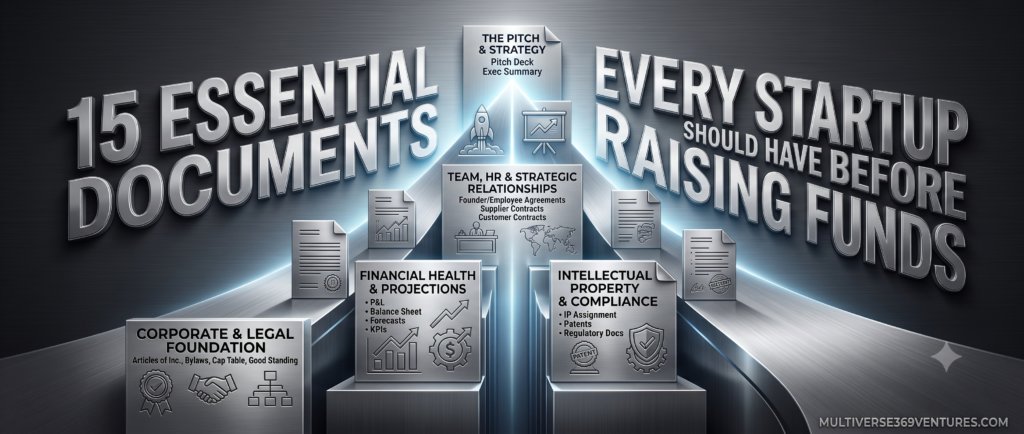
To ensure you are fully prepared for the due diligence process, here is the definitive guide to the 15 essential documents every startup must have ready before raising funds.
Part 1: Corporate & Legal Foundation
The first thing investors look for is proof that your business is a legally sound, compliant entity. If the foundation is cracked, no amount of revenue will convince a serious investor to wire funds.
1. Articles of Incorporation
Your Articles of Incorporation (or Certificate of Incorporation) establish your company’s legal existence. Filed with your state or jurisdiction, this document outlines the fundamental details of your business, including its name, registered agent, corporate structure, and the initial authorization of shares.
- Why Investors Need It: VCs and institutional investors typically mandate specific corporate structures (such as a Delaware C-Corporation in the US) because they offer predictable legal frameworks and allow for the issuance of preferred stock.
- Common Pitfall: Operating as an LLC while trying to raise venture capital. Most VCs cannot invest in pass-through entities due to their own fund structures.
2. Corporate Bylaws or Operating Agreement
While the Articles of Incorporation create the company, the bylaws dictate how it is governed. This document outlines the rules for holding board meetings, electing directors, shareholder voting rights, and the general management of the company.
- Why Investors Need It: It shows who actually has the power to make decisions, how board seats are allocated, and the protocols for major corporate actions.
3. Comprehensive Capitalization Table (Cap Table)
A cap table is a spreadsheet detailing exactly who owns what percentage of the company. It lists the founders, early employees, advisors, and previous investors, alongside the type of shares they hold (common vs. preferred), options, and warrants.
- Why Investors Need It: Investors use your current cap table to create a “pro forma” cap table, which models how their investment will dilute existing shareholders.
- Pro Tip: Always present a fully diluted cap table. This means calculating ownership assuming all authorized stock options are issued and all convertible notes (like SAFEs) have converted to equity.
4. Certificate of Good Standing
This is a state-issued document proving that your corporation is legally authorized to do business in its home state, has filed all necessary annual reports, and has paid all required franchise taxes.
- Why Investors Need It: It acts as a quick health check. A suspended corporate status due to a missed $50 state fee can needlessly delay a multi-million dollar funding round by weeks.
Part 2: Financial Health & Projections
Numbers tell the true story of your operational discipline. Investors will verify every claim made in your pitch deck against the hard data in your financial statements.
5. Historical Profit & Loss (P&L) Statements
Your Income Statement, or P&L, tracks your revenues, costs of goods sold (COGS), and operating expenses over a specific period. You should have trailing 12-to-24-month statements ready, broken down by month.
- Why Investors Need It: They want to see your revenue trajectory, cash burn rate, and margin profile. If you are selling physical goods, investors will closely scrutinize your COGS to ensure your gross margins can sustain long-term growth.
6. Current Balance Sheet
The balance sheet provides a snapshot of your company’s financial position at a specific moment in time. It details your assets (cash, inventory, accounts receivable) and your liabilities (debts, accounts payable).
- Why Investors Need It: For an e-commerce or retail brand, the balance sheet is highly scrutinized for inventory levels. Having capital unnecessarily tied up in slow-moving stock—whether that’s self-adhesive wall hooks, pull string choppers, or grooming electronics—signals poor cash flow management.
7. Pro Forma Financial Projections (3-5 Years)
You need a forward-looking financial model detailing expected revenue, expenses, and cash flow for the next 3 to 5 years.
- Why Investors Need It: Investors know your Year 5 projections will likely be wrong. What they are actually testing is the logic behind your assumptions. Are your hiring plans realistic? Are your marketing budgets aligned with your revenue goals? The financial model proves how you plan to deploy their capital.
8. Unit Economics & KPI Dashboard
Traditional accounting doesn’t always capture the nuances of digital growth. Startups need a supplemental workbook detailing key performance indicators (KPIs) like Customer Acquisition Cost (CAC), Lifetime Value (LTV), monthly recurring revenue (MRR), and churn rates.
- E-Commerce Context: If you are scaling an omnichannel brand across platforms like Amazon or Flipkart, your unit economics must clearly account for marketplace fulfillment fees, storage costs, and advertising spend (PPC) to show true profitability per unit sold.
Part 3: Intellectual Property & Compliance
Defensibility is a massive driver of valuation. Investors want to know that you own the assets that make you valuable and that you are protected against regulatory threats.
9. IP Assignment Agreements
Every founder, employee, and contractor who has ever worked on your product must sign an Intellectual Property Assignment Agreement. This document legally transfers the ownership of any code, designs, or innovations they created from them as individuals to the company.
- Why Investors Need It: If a founder leaves, or an external graphic designer claims they actually own the rights to your brand assets, the company’s valuation plummets. Clean IP assignment is non-negotiable.
10. Trademarks, Patents, and Copyrights
Documentation of your registered intellectual property is crucial. This includes utility patents for physical products, software algorithms, or trademarks for your brand identity.
- Brand Identity Protection: Protecting your visual identity is critical. For example, if your brand relies on a highly specific aesthetic—such as a stark, icon-less 3D monolithic typography where a primary wordmark is black and a numerical suffix is metallic silver—registering that specific trade dress and logo protects you from knock-offs in crowded digital marketplaces.
11. Regulatory & Platform Compliance Records
If your startup operates in a regulated space, or relies heavily on third-party marketplace ecosystems, you must prove compliance.
- Real-World Application: Consider a brand selling professional grooming tools, like hair trimmers, on Amazon. These products often contain lithium-ion batteries. Providing investors with your updated Material Safety Data Sheets (MSDS), UN38.3 test summaries, and hazardous material (Hazmat) exemption clearances proves that your core revenue drivers are not at risk of being abruptly delisted by marketplace algorithms.
Part 4: Team, HR & Strategic Relationships
A startup is only as valuable as the team executing the vision and the partners supporting the supply chain.
12. Founder & Key Employee Agreements
Include the employment contracts for all founders and C-suite executives. These documents should clearly outline compensation, roles, and—most importantly—vesting schedules for equity.
- Why Investors Need It: Investors are funding the team as much as the product. They want to ensure founders have a standard four-year vesting schedule with a one-year cliff. If a founder can walk away the day after funding with 30% of the company’s equity, the startup is un-investable.
13. Material Vendor and Supplier Contracts
You must include copies of all major contracts with third-party suppliers, contract manufacturers, and logistics partners.
- Why Investors Need It: Supply chain resilience is heavily audited. If you are importing high-volume home utility products, investors will review your manufacturer Service Level Agreements (SLAs), payment terms (e.g., Net-30 vs. Net-60), and exclusivity clauses to gauge how insulated you are from supply shocks.
14. Key Customer Contracts
If you are a B2B startup, include your top 5 to 10 largest customer contracts.
- Why Investors Need It: They will review the terms for cancellation clauses, renewal guarantees, and payment structures to verify the quality and reliability of your revenue.
Part 5: The Pitch & Strategy
Finally, the documents that synthesize your entire business into a compelling narrative and outline the terms of the deal.
15. The Pitch Deck & Executive Summary
While this is usually the first document an investor sees, an updated, highly polished version should live in your data room. The deck should concisely cover the problem, your solution, market size, business model, competitive advantage, and the founding team. The Executive Summary serves as a 1-to-2 page written distillation of the deck.
- Why Investors Need It: It acts as the anchor point for their internal investment memos. When a partner has to pitch your startup to the rest of their firm, they will borrow heavily from the narrative you construct in your deck.
Bonus: The Term Sheet Template or Offering Memorandum
If you are leading the round (pricing it yourself) or using standard convertible instruments, have your templates ready. If you are raising early-stage capital, having a clean, standard SAFE (Simple Agreement for Future Equity) drawn up shows you are ready to close instantly when an investor says yes.
Final Thoughts for Founders
Building a data room is not a task you can afford to leave for the night before a partner meeting. It requires weeks of collaboration between your executive team, your legal counsel, and your accountants.
When a venture capitalist or private equity firm requests access to your diligence files, providing a beautifully organized, secure, and fully populated data room sends a powerful psychological signal: We are competent, we are organized, and we are ready to scale.
Take the time to gather these 15 essential documents now, pressure-test your financial models, and ensure your legal foundation is bulletproof. When the time comes to scale your ventures to the next level, you will negotiate from a position of profound strength.