
A Complete Guide to Building a Smarter, More Cost-Effective Business with Virtual Teams
Published by Multiverse369 Ventures
Introduction
Running a successful business has never been more challenging. Companies today face rising operational costs, increasing competition, talent shortages, and growing customer expectations. From startups and small businesses to large enterprises, every organization is looking for ways to improve productivity while controlling expenses.
Traditionally, expanding a business meant hiring more full-time employees, renting larger office spaces, purchasing additional equipment, and increasing administrative overhead. While this approach worked for many years, it is no longer the only—or the most efficient—way to grow.
Today, businesses around the world are embracing Virtual Employees as a smarter and more flexible workforce solution. Advances in cloud technology, collaboration tools, video conferencing, and secure remote working platforms have made it possible for talented professionals to work effectively from anywhere in the world.
Virtual employees are helping companies reduce operational costs, improve efficiency, access specialized talent, and scale faster—all without compromising quality.
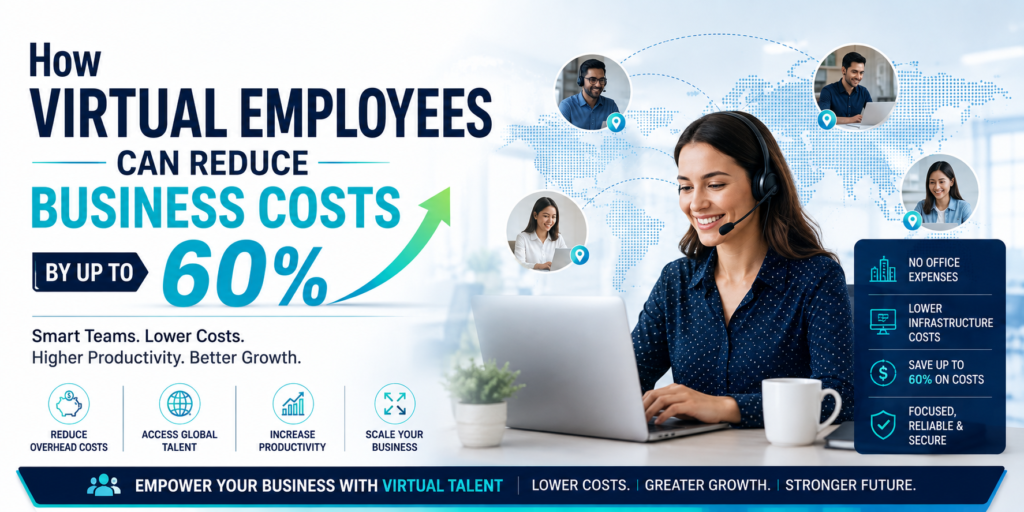
In many cases, businesses can reduce certain operational costs by up to 60%, depending on the roles outsourced and how effectively remote teams are managed. The exact savings vary based on industry, location, salary structures, office expenses, and business operations.
In this guide, we’ll explain how virtual employees work, where businesses save money, the roles best suited for remote work, common misconceptions, and how Multiverse369 Ventures helps organizations build high-performing virtual teams.
What Are Virtual Employees?
Virtual employees are professionals who work remotely while performing the same responsibilities as in-house staff. Instead of working from your office, they operate from a remote location using secure digital tools and communication platforms.
They become an extension of your existing team and collaborate through:
- Microsoft Teams
- Zoom
- Google Meet
- Slack
- Trello
- Asana
- Monday.com
- ClickUp
- Cloud storage platforms
- CRM systems
Virtual employees can work full-time, part-time, or on project-based assignments depending on your business requirements.
Why Businesses Are Choosing Virtual Employees
The global workforce has changed dramatically over the past decade.
Businesses have realized that productivity is no longer determined by where employees work but by how effectively they perform.
Organizations now prioritize:
- Lower operating costs
- Greater flexibility
- Faster hiring
- Access to global talent
- Improved scalability
- Business continuity
- Better work-life balance
As a result, virtual staffing has become a long-term business strategy rather than a temporary trend.
Understanding the Potential Cost Savings
Many businesses hear claims about reducing costs by 60% and wonder how this is possible.
The savings do not usually come from paying lower salaries alone. Instead, they result from reducing multiple overhead expenses associated with maintaining traditional office-based teams.
Potential savings may include:
- Office rent
- Utilities
- Internet infrastructure
- Furniture
- Office equipment
- Computer hardware
- Employee transportation support
- Cafeteria expenses
- Facility maintenance
- Office administration
- Recruitment costs
- Training expenses
When combined, these savings can significantly reduce operational expenses.
Where Businesses Save Money
1. Office Space Costs
Office rent is one of the largest recurring business expenses.
Each additional employee requires:
- Desk space
- Meeting rooms
- Utilities
- Maintenance
- Cleaning
- Security
Virtual employees eliminate much of this requirement.
Businesses can maintain smaller offices while supporting larger teams remotely.
2. Equipment and Infrastructure
Traditional employees often require:
- Desktop computers
- Office desks
- Chairs
- Printers
- Network equipment
- Office telephones
Many virtual professionals already have well-equipped workstations, reducing the need for additional infrastructure investments.
3. Recruitment Costs
Hiring locally often involves:
- Recruitment agencies
- Job advertisements
- Interview scheduling
- Multiple hiring rounds
Virtual staffing enables businesses to access qualified candidates from broader talent pools, which can shorten hiring timelines for many roles.
4. Administrative Expenses
Larger offices require additional support staff.
Examples include:
- Receptionists
- Office administrators
- Facility management
- Maintenance teams
Remote teams naturally reduce many of these administrative costs.
5. Employee Benefits
Depending on local employment laws and company policies, businesses may reduce certain overhead expenses related to office operations when using remote workforce models.
However, employers should always comply with applicable labor laws and provide fair compensation and benefits where required.
Roles That Work Well as Virtual Employees
Not every job can be performed remotely, but many knowledge-based roles are ideal for virtual staffing.
Examples include:
Technology
- Software Developers
- Web Developers
- Mobile App Developers
- QA Testers
- UI/UX Designers
- IT Support
Marketing
- SEO Specialists
- Digital Marketing Managers
- Social Media Managers
- Content Writers
- Graphic Designers
- Video Editors
- Email Marketing Specialists
Business Support
- Virtual Assistants
- Customer Support Representatives
- Data Entry Professionals
- CRM Administrators
- Project Coordinators
Finance
- Bookkeepers
- Accountants
- Payroll Specialists
- Financial Analysts
Human Resources
- Recruiters
- HR Coordinators
- Talent Acquisition Specialists
Sales
- Lead Generation Specialists
- Appointment Setters
- Inside Sales Representatives
- CRM Managers
Benefits Beyond Cost Savings
Reducing costs is only one advantage.
Virtual employees also help businesses:
- Hire faster
- Expand globally
- Operate across time zones
- Improve flexibility
- Access specialized skills
- Increase productivity
- Support business continuity
- Scale operations quickly
These strategic benefits often have a greater long-term impact than cost reduction alone.
Access to Global Talent
Hiring locally limits your talent pool.
Virtual staffing enables businesses to recruit professionals based on skills rather than geography.
Instead of searching within one city, companies can access qualified professionals from multiple regions and countries.
This improves hiring quality while reducing recruitment time.
Increased Business Flexibility
Business needs change throughout the year.
Some periods require:
- Additional customer support
- Seasonal marketing
- Temporary developers
- Short-term designers
- Project managers
Virtual staffing makes it easier to adjust team size without the long-term commitments associated with traditional hiring.
Improved Productivity
Many business leaders assume employees are only productive inside an office.
Research and real-world experience suggest productivity depends more on:
- Clear expectations
- Effective communication
- Performance measurement
- Appropriate technology
- Good management
With the right systems in place, virtual employees can deliver excellent results while working remotely.
Technology Makes Remote Work Easy
Modern collaboration tools have transformed remote work.
Businesses can now manage virtual teams using:
- Video meetings
- Shared documents
- Project management software
- Cloud storage
- Time tracking
- Instant messaging
- Digital workflows
These technologies create transparency and improve collaboration regardless of location.
Common Myths About Virtual Employees
Myth 1: Remote Employees Are Less Productive
Reality:
Performance depends on management, communication, and measurable goals—not office location.
Myth 2: Communication Is Difficult
Reality:
Modern collaboration platforms allow real-time communication through video calls, messaging, file sharing, and project management tools.
Myth 3: Virtual Teams Are Less Reliable
Reality:
Professional virtual employees follow structured workflows, defined KPIs, and performance reviews, just like in-house staff.
Myth 4: Only Startups Use Virtual Employees
Reality:
Businesses of all sizes—including multinational corporations—use remote teams for technology, customer support, finance, marketing, and operations.
Best Practices for Managing Virtual Employees
Successful businesses follow several key principles:
- Set clear expectations.
- Define measurable KPIs.
- Schedule regular meetings.
- Use project management software.
- Encourage collaboration.
- Provide ongoing feedback.
- Document processes.
- Celebrate achievements.
Effective leadership remains essential regardless of where employees work.
When Should Your Business Hire Virtual Employees?
Consider virtual staffing if:
- Hiring costs are increasing.
- Office space is limited.
- Growth is accelerating.
- Projects require specialized skills.
- Customer demand is increasing.
- You need faster recruitment.
- Administrative costs continue rising.
- You want greater operational flexibility.
Virtual staffing is particularly valuable for startups and growing businesses seeking to scale efficiently.
Virtual Employees vs Traditional Employees
| Factor | Virtual Employees | Traditional Employees |
|---|---|---|
| Office Space | Not usually required | Required |
| Infrastructure Costs | Lower | Higher |
| Talent Pool | Global | Mostly local |
| Hiring Flexibility | High | Moderate |
| Scalability | Faster | Slower |
| Collaboration | Digital tools | In-person & digital |
| Operational Costs | Often lower | Typically higher |
The right choice depends on your business model, the role, and operational requirements. Many organizations use a hybrid workforce that combines both virtual and office-based employees.
How to Build a Successful Virtual Team
Building an effective remote workforce requires more than hiring talented individuals.
A structured approach includes:
Step 1
Identify roles suitable for remote work.
Step 2
Create detailed job descriptions.
Step 3
Hire qualified professionals.
Step 4
Implement secure collaboration tools.
Step 5
Provide onboarding and training.
Step 6
Monitor performance using measurable KPIs.
Step 7
Maintain regular communication.
Following these steps helps businesses maximize the value of virtual staffing.
How Multiverse369 Ventures Supports Virtual Workforce Solutions
At Multiverse369 Ventures, we help businesses build reliable, high-performing virtual teams that align with their growth objectives. Our approach begins with understanding your operational needs, business goals, and workforce requirements before recommending the right staffing strategy.
Our Virtual Employee solutions include:
- Dedicated Virtual Employees
- Administrative Support
- Customer Support Teams
- Technology Professionals
- HR & Recruitment Support
- Digital Marketing Specialists
- Finance & Accounting Assistance
- Sales Support
- Business Process Outsourcing (BPO)
- Project-Based Staffing
- Remote Team Management Guidance
We also provide complementary services such as Business Consulting, Technology Consulting, HR Consulting, Funding Advisory, Financial Services, and Business Process Outsourcing, enabling businesses to build scalable operations with confidence.
Whether you’re a startup looking to reduce operational costs or an established company seeking flexible workforce solutions, our experienced consultants can help you design a staffing model that supports sustainable growth.
Frequently Asked Questions
Are virtual employees full-time workers?
Yes. They can work full-time, part-time, or on project-based assignments depending on your business needs.
Can virtual employees work in different time zones?
Yes. Many businesses intentionally build distributed teams to provide extended customer support or continuous operations.
Is virtual staffing secure?
It can be, provided appropriate cybersecurity measures, secure access controls, and company policies are implemented.
Will virtual employees replace in-house staff?
Not necessarily. Many organizations adopt a hybrid model, combining in-office and remote employees to balance flexibility with operational needs.
Final Thoughts
Virtual employees have transformed the way modern businesses operate. Rather than being a temporary solution, remote staffing has become a strategic advantage for organizations seeking to control costs, access specialized talent, and scale efficiently.
While the exact savings vary by business, many companies can substantially reduce operational expenses by lowering office-related overhead, streamlining recruitment, and building flexible workforce models. More importantly, virtual employees enable businesses to remain agile, adapt to changing market conditions, and focus resources on innovation and growth.
Success, however, depends on thoughtful planning, the right technology, clear communication, and effective management. Businesses that invest in these foundations are well-positioned to benefit from the flexibility and efficiency of virtual teams.
At Multiverse369 Ventures, we help businesses implement practical virtual workforce solutions tailored to their unique goals. By combining expert consulting with reliable virtual staffing services, we empower startups, SMEs, and enterprises to build stronger, more scalable organizations ready for long-term success.