
What Makes an Investment Opportunity “Investment-Ready”?
Discover the key characteristics investors look for when evaluating businesses, projects and potential investment opportunities.
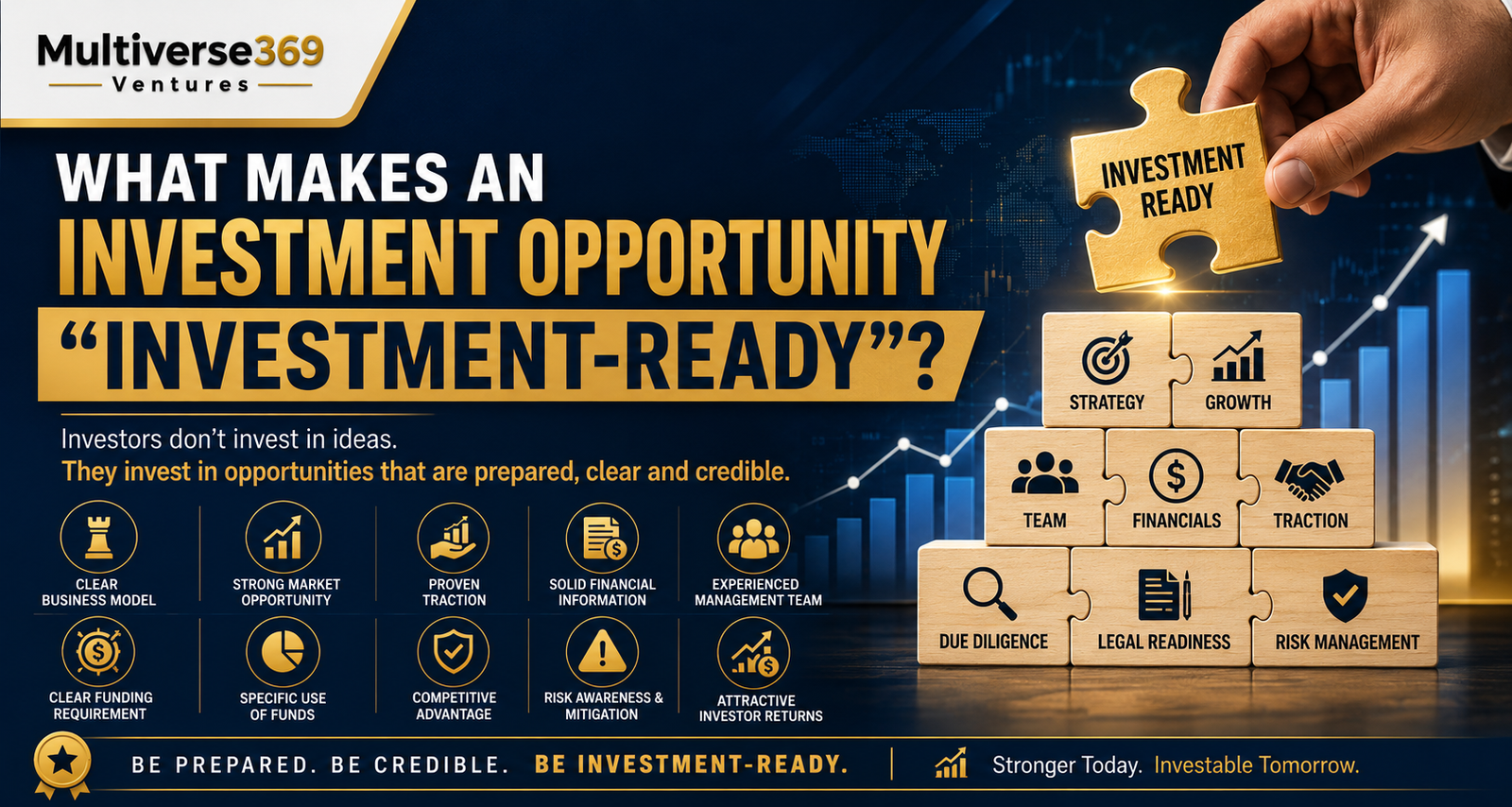
Why Investment Readiness Matters
Finding investment opportunities is relatively easy. Finding opportunities that are genuinely ready for investment is much harder.
Investors, venture capital firms, private equity firms, family offices, lenders, and other capital providers receive countless business proposals. Yet only a small percentage of these opportunities may have the combination of market potential, financial visibility, management capability, scalability, realistic funding requirements, and risk awareness necessary to justify serious consideration.
For entrepreneurs, this creates an important distinction:
An investment-ready opportunity is one where an investor can clearly understand what the business does, why it can grow, how capital will be used, what risks exist, and how the investment could potentially generate an appropriate return.
What Does “Investment-Ready” Actually Mean?
An investment-ready business or project has progressed beyond simply having an idea or needing capital.
It has enough information, structure, evidence, and strategic clarity for a potential investor to begin a meaningful evaluation.
Clear Business Model
A clearly defined model explaining how the business creates and captures value.
Market Opportunity
An identifiable market with customer demand and meaningful growth potential.
Financial Visibility
Organized financial information and realistic projections that investors can evaluate.
Management Capability
A team with the skills and experience required to execute the business strategy.
Funding Clarity
A specific capital requirement supported by a clear use-of-funds strategy.
Risk Awareness
A realistic understanding of business risks and how they may be managed.
A Clear and Understandable Business Model
The first question an investor needs answered is simple: How does this business make money?
An investment opportunity should clearly explain its revenue model, customers, products or services, pricing strategy, distribution channels, and major operating costs.
A strong investment opportunity should be able to explain:
- What problem does the business solve?
- Who pays for the solution?
- Why do customers choose this business?
- How does the company generate revenue?
- What are the major costs?
- What drives profitability?
- How can the business grow?
The objective is to make the economics understandable.
A Real Market Opportunity
Investors are not only investing in today’s business. They are often investing in the possibility of future growth.
A business should demonstrate that there is a meaningful market for its product or service and explain where future growth could come from.
- Market Size: How large is the addressable market?
- Market Growth: Is the industry expanding, stable, or declining?
- Customer Demand: Is there evidence customers want the solution?
- Competition: Who are the existing competitors?
- Differentiation: Why can this business compete effectively?
- Expansion Potential: Can the business enter new markets or segments?
Evidence of Traction
One of the biggest differences between an idea and an investment-ready opportunity is evidence.
Depending on the stage of the business, traction can take many forms.
- Paying customers
- User growth
- Pilot customers
- Partnerships
- Recurring revenue
- Product adoption
- Customer retention
- Letters of intent
- Revenue growth
- Profitability
- Cash flow
- Market share
Traction provides evidence of what is already happening.
Strong and Transparent Financial Information
Financial information is one of the most important components of investment readiness.
Investors need to understand the company’s current financial position and how it expects to perform in the future.
- Income statements
- Balance sheets
- Cash-flow statements
- Revenue breakdown
- Gross margins
- Operating expenses
- Existing debt
- Historical financial performance
- Financial projections
- Cash requirements
The objective should always be credible financial information rather than overly optimistic projections.
A Clearly Defined Funding Requirement
One of the biggest weaknesses in many investment proposals is an unclear funding request.
An investment-ready opportunity should explain:
The funding request should be connected to a realistic business plan and explain how capital will support growth.
A Specific Use of Funds
Investors want to know where their capital is going. A strong proposal should clearly explain the intended use of funds.
| Use of Capital | Potential Allocation |
|---|---|
| Technology & Product Development | 25% |
| Sales & Marketing | 30% |
| Hiring & Management | 20% |
| Equipment / Infrastructure | 15% |
| Working Capital | 10% |
The exact allocation will depend on the business. The important principle is clarity.
An Experienced and Credible Management Team
Businesses are ultimately operated by people. Even a strong market opportunity can fail because of poor execution.
Investors may consider:
- Industry experience
- Entrepreneurial track record
- Relevant technical expertise
- Financial management capability
- Leadership experience
- Previous business performance
- Ability to execute the proposed strategy
- Alignment with investors
Scalability
Investors generally want to understand how the business can grow.
Scalability may come from:
- Technology
- Automation
- Distribution networks
- Franchising
- Recurring revenue
- Digital products
- Manufacturing efficiencies
- Geographic expansion
- Strategic partnerships
Not every investment needs to be a high-growth technology startup. A real-estate project, established SME, acquisition opportunity, or private-credit transaction may have a completely different growth or return profile.
A Realistic Competitive Advantage
Saying “we have no competition” is rarely persuasive. Almost every business competes with something.
An investment-ready opportunity should identify:
- Direct competitors
- Indirect competitors
- Barriers to entry
- Customer switching costs
- Intellectual property
- Brand strength
- Distribution advantages
- Technology advantages
- Strategic partnerships
Legal and Corporate Readiness
Before serious investment discussions progress, investors may need access to corporate and legal information.
- Company incorporation documents
- Ownership structure
- Cap table
- Existing shareholder agreements
- Intellectual property documentation
- Material contracts
- Licenses
- Regulatory documents
- Existing financing agreements
- Litigation information
- Tax documentation
Understanding the Risks
A credible investment opportunity should not pretend that everything is perfect.
Every business has risks, including:
- Market risk
- Competitive risk
- Customer concentration
- Regulatory risk
- Technology risk
- Financial risk
- Operational risk
- Management risk
- Supply-chain risk
- Economic conditions
They want to understand what could go wrong and how those risks may be managed.
A Realistic Investor Return Proposition
Investment-ready does not simply mean “we need money.” It means there should be a logical investment proposition.
Depending on the structure, investors may evaluate:
- Equity ownership
- Potential capital appreciation
- Dividend potential
- Interest income
- Debt repayment
- Preferred returns
- Exit opportunities
- Strategic value
- Asset-backed protection
The structure depends heavily on the type of transaction. A private-credit opportunity and a venture-capital investment will have very different return mechanisms.
A Professional Pitch Deck
A pitch deck is often the first structured document an investor sees. A strong pitch deck should communicate the investment opportunity quickly and logically.
Investment-Ready vs. Simply Looking for Funding
There is a significant difference between simply looking for funding and presenting an investment-ready opportunity.
| Simply Looking for Funding | Investment-Ready Opportunity |
|---|---|
| “We need capital.” | Clearly defined funding requirement |
| Limited financial information | Organized financial information |
| General business description | Clearly defined business model |
| Mostly future projections | Evidence and traction |
| Unclear use of funds | Specific capital allocation |
| Focused primarily on raising money | Focused on creating investor value |
| Limited risk discussion | Transparent risk assessment |
| Basic presentation | Structured investment materials |
| No clear investor proposition | Defined potential return/value proposition |
They are looking for opportunities where capital can potentially create value.
How Multiverse369 Ventures Can Help Create Investment-Ready Opportunities
At Multiverse369 Ventures, we work with businesses, entrepreneurs and organizations across different stages of growth.
Our broader business and investment-related services include areas such as:
Startup & Business Strategy
Strategic guidance for startups and businesses working toward sustainable growth.
Funding Advisory
Support around funding requirements, investor readiness and capital strategy.
Investment Advisory
Support related to private equity, expansion capital and investment opportunities.
Financial Solutions
Business loans, financial services and other potential financing solutions.
Technology Consulting
Technology and digital transformation support for growing organizations.
Growth Support
HR, recruitment, virtual employees, BPO and growth strategy solutions.
Our approach begins with understanding the business, its objectives, funding requirements, challenges and growth opportunities.
For businesses seeking capital, the objective is not simply to say:
The more important question is:
Multiverse369 Ventures can help businesses organize their growth and funding requirements and explore potential connections within its broader network of investors, financial institutions, strategic partners and other capital providers.
The Investment-Ready Checklist
Before approaching investors, a business should be able to answer “yes” to most of these questions:
Is our business model clear?
Do we understand our target customer?
Is there a meaningful market opportunity?
Can we demonstrate customer demand?
Are our financial records organized?
Do we know exactly how much capital we need?
Can we explain why we need the capital?
Do we have the right people to execute?
Can we explain potential investor value?
Do we understand the key risks?
Are our investment materials professionally prepared?
Do we have a credible growth strategy?
Final Thoughts
Being investment-ready is not about creating the most attractive pitch.
Investors need to understand the business, market, management team, financial position, capital requirement, growth strategy, risks and potential value creation opportunity.
The strongest investment opportunities combine clarity with evidence.
They don’t simply say:
They demonstrate:
That is what makes an opportunity genuinely investment-ready.
And in an increasingly competitive investment environment, preparation can be the difference between being overlooked and getting a serious investor conversation.
Is Your Business Investment-Ready?
If you’re preparing your business for funding, investment or expansion, take the next step by exploring how Multiverse369 Ventures can support your business growth and funding journey.
Submit Your Pitch Deck